
Is Your Roster Really Just a Timetable?
Why a structured approach to rostering saves time, reduces errors and keeps your team happier — and how to know when it's time to outsource it.
When you look at your staff roster, do you see a list of names, days and shift times, or do you see one of the most important operational tools in your business?
For many business owners and managers, rostering is treated as a necessary administrative task. You work out who is available, fill the required shifts, send the roster out and move on to the next job.
On the surface, that makes sense.
A roster certainly needs to tell people when they are working. However, a good roster does much more than that.
Your roster influences labour costs, staff morale, customer service, productivity, communication and the way your business runs from one day to the next.
When rostering is working well, you may barely notice it.
When it is not, the problems can spread through almost every part of your business.
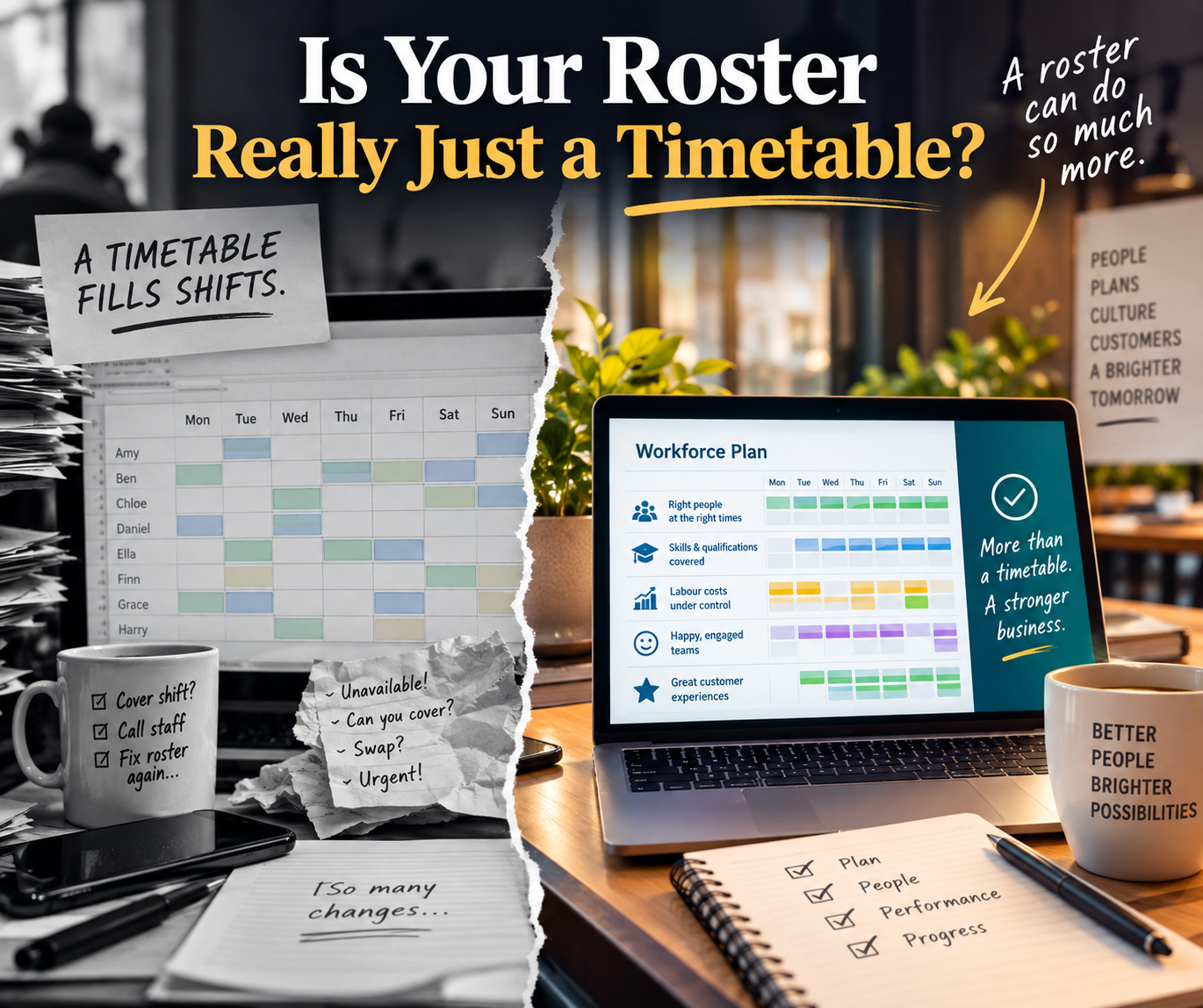
The Problem With Treating a Roster Like a Timetable
A timetable simply tells you when something is happening.
A roster needs to tell you much more.
It needs to make sure you have enough people working at the right times. It needs to take different skills, responsibilities and experience levels into account. It needs to consider staff availability while still meeting the needs of the business.
Depending on your industry, you may also need to consider qualifications, ratios, opening and closing responsibilities, break requirements, award conditions and minimum staffing levels.
That makes rostering much more complex than placing names into boxes.
Imagine two rosters that both have the same number of employees working.
On paper, they may appear identical.
In reality, one roster could have the right combination of experienced staff, supervisors and newer employees working together. The other could leave an inexperienced team dealing with the busiest period of the week.
Both rosters technically filled the shifts.
Only one roster properly supported the business.
That is the difference between creating a timetable and creating an effective staffing plan.
Poor Rostering Creates Problems You May Not Immediately Connect to the Roster
One of the reasons rostering problems can be difficult to identify is that they do not always look like rostering problems.
Perhaps staff regularly ask to swap shifts.
Perhaps one or two employees seem to be carrying far more responsibility than everyone else.
Perhaps your labour costs keep creeping upward.
Perhaps managers are spending hours each week fixing staffing problems.
Perhaps customers complain about slow service at certain times.
Perhaps staff are becoming frustrated because they feel the roster is unfair.
These issues may appear unrelated, but the roster can often be sitting somewhere in the background.
A poorly planned roster can create a chain reaction.
Someone is unavailable, so another employee is asked to stay longer.
That employee then works additional hours.
A manager needs to rearrange breaks.
Another employee becomes frustrated because they believe certain staff always receive the preferred shifts.
Someone else asks to swap their weekend.
Suddenly, the roster you spent hours creating has changed multiple times before the week has even started.
The original timetable may still exist, but the business is now operating from messages, emails, conversations and last-minute changes.
That creates confusion.
Last-Minute Rostering Has a Cost
The cost of poor rostering is not limited to wages.
There is also a cost in management time.
Every phone call about a shift change takes time. Every message asking whether someone can cover another employee takes time. Every correction to the roster takes time.
If you are the person responsible for rostering, think about how often you return to it after you believe it is finished.
Do you create the roster once, or do you continue working on it throughout the week?
A roster that requires constant repair is not really finished.
There is also a cost to your staff.
Employees want to know when they are working so they can organise the rest of their lives.
Constant changes make that difficult.
People have families, appointments, sporting commitments, study and other responsibilities. When rosters change repeatedly, staff can begin to feel that their personal time has little value.
That frustration can quickly become a workplace issue.
Your Roster Sends a Message to Your Staff
Every roster communicates something.
It communicates who is trusted with responsibility.
It shows how weekend and unpopular shifts are shared.
It shows whether availability has been considered.
It can reveal whether certain people are regularly relied upon to solve staffing problems.
Staff notice these things.
You may not hear about every frustration, but employees usually know who receives the preferred shifts and who seems to be called whenever someone else is unavailable.
They also notice whether the roster appears organised.
A clear, predictable roster creates confidence.
A chaotic roster creates uncertainty.
This does not mean every employee will always receive exactly the shifts they want. That is rarely possible.
The business still needs to come first.
However, a strong rostering system creates clear expectations and a consistent process. Staff understand how shifts are allocated, how availability is communicated and what happens when someone needs a change.
That clarity can prevent many problems before they begin.
A Good Roster Protects Your Business
Your roster should also help you see what is happening across your workforce.
Are the same people regularly working overtime?
Are certain days consistently overstaffed?
Are you paying additional wages because shifts have not been structured properly?
Do you have enough experienced staff working during busy periods?
Are your managers spending too much time covering gaps?
Are some employees being underutilised?
These are business questions, not simply scheduling questions.
A well-designed roster gives you information that helps you make better decisions.
For example, you may discover that Tuesday mornings consistently require fewer staff than you have been scheduling.
You might find that Friday afternoons regularly become understaffed because customer demand increases.
Perhaps one employee is constantly being asked to work extra hours because no one else with the required skill has been scheduled.
Once you recognise those patterns, you can begin fixing the cause rather than repeatedly dealing with the result.
Rostering Should Be Proactive, Not Reactive
Many businesses create rosters reactively.
They start with staff availability then attempt to fill all the required shifts.
A stronger approach starts with the needs of the business.
What needs to happen during each part of the day?
How many people are required?
What skills need to be available?
Where are the busiest periods?
Which responsibilities need to be covered?
Once those requirements are clear, staff can be allocated around them.
This changes the question from:
"Who can work?"
to:
"What does the business need, and who is the right person to meet that need?"
That may sound like a small difference, but it can completely change the quality of the roster.
Systems Reduce the Pressure
Good rostering does not rely on memory.
It relies on systems.
Staff availability should be clear.
Leave should be recorded.
Regular commitments should be visible.
Qualifications and responsibilities should be known.
Requests for changes should follow a consistent process.
The roster should also have clear boundaries around when changes can be made and who is responsible for approving them.
Without systems, rostering can easily become one person trying to remember dozens of individual arrangements.
"Sarah cannot work Tuesday mornings."
"John needs to leave early every second Friday."
"Michelle asked for next Saturday off."
"David swapped with Mark last week."
Trying to manage all of that mentally is exhausting.
A system removes much of that pressure.
It allows the person creating the roster to focus on building the best staffing structure rather than trying to remember information scattered across messages and conversations.
Your Roster Is Part of Your Business Strategy
When rostering is done well, it supports much more than staffing.
It can help control labour costs.
It can improve productivity.
It can give managers more time.
It can reduce unnecessary shift changes.
It can create clearer expectations for staff.
It can help you identify workforce problems before they become serious.
Most importantly, it can make the business easier to run.
That is why I do not believe a roster should ever be viewed as simply a timetable.
It is an operational plan.
It connects your people with the work that needs to be done.
It determines who is available to serve your customers, support your team and keep the business functioning.
If creating your roster feels like a weekly battle, the answer may not be to spend more time working on it.
The answer may be to look at the system behind it.
Because a good roster does not simply tell your staff when to turn up.
It helps your entire business work better.
Ready to take back your time?
Book a free strategy call and see how we can simplify your rostering.
Book Your FREE Strategy Call